Two-day Global Prosperity Summit 2026 officially opens
Highlights include keynote on "China's Global Governance Initiative", two timely panel discussions
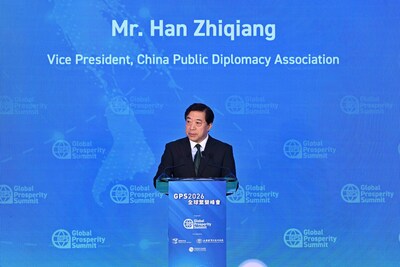
HONG KONG, May 19, 2026 /PRNewswire/ -- The organisers of Global Prosperity Summit 2026 (GPS 2026) announced that the event's third consecutive edition opened today, shining spotlights on issues critical to Hong Kong's future development and global prosperity. Ambassador Han Zhiqiang, Vice President of the China Public Diplomacy Association, delivered a keynote address that offered profound and forward-looking insights into China's Global Governance Initiative.
In his keynote speech entitled "China's Global Governance Initiative", Ambassador Han Zhiqiang said:
- The international landscape is beset by mounting instability and uncertainty. Unilateralism and protectionism are on the rise. Geopolitical conflicts continue to flare up, development gaps are widening, and global challenges are emerging one after another. These developments have made reform and improvement of global governance an urgent task for all countries and peoples.
- The Global Governance Initiative has been launched in response to the needs of the world with the following emphasis:
- The most unequivocal message: a call for strong solidarity. Countries must come together to meet challenges and forge a consensus and a force for solidarity and cooperation to overcome division and confrontation.
- The most steadfast position: upholding multilateralism. Global affairs should be discussed by all, the global governance system built by all, and the governance outcomes shared by all. All acts of unilateralism must be rejected.
- The most cherished vision: a future of fairness and justice. It calls for greater representation and voice for developing countries and rejects bullying of the small and weak. It calls for closing the North-South gap as soon as possible.
- Today, international cooperation on development is losing steam. We should put development back at the center of international agenda, mobilize global resources for development, and foster an equal and balanced global development partnership.
- As we all advance toward a brighter future of a community with a shared future for humanity, China is ready to work with the international community to ensure that the Initiative takes root and yields fruitful outcomes.
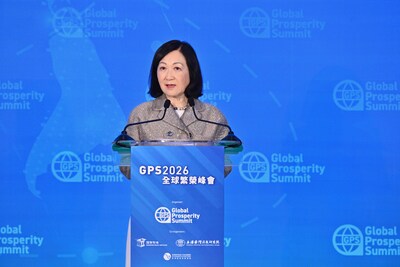
In her welcome remarks, Mrs Regina Ip, Founder of the Global Prosperity Summit and Chairperson of the Board of Governors of the Savantas Policy Institute, said, "The Summit can serve as a platform for dialogue, exchange and pragmatic cooperation. Our discussions will focus on the profound economic, technological and scientific transformations reshaping the world before our eyes. Amid uncertainties, Hong Kong continues to stand out as an oasis of stability, connectivity and opportunity."
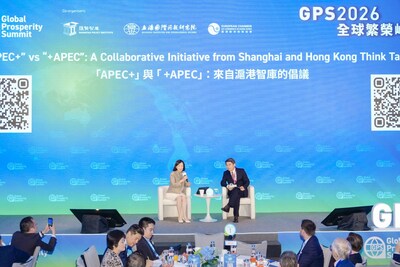
Mrs Regina Ip and Professor Kaisheng Li, Vice-President of the Shanghai Institutes for International Studies, also delivered a joint briefing titled "'APEC+' vs '+APEC': A Collaborative Initiative from Shanghai and Hong Kong Think Tanks", with the following key points:
- Professor Kaisheng Li:
- President Trump finished his state visit to China days ago, a very important event for the world economic order, for the China-U.S. relations. [This was] a critical moment to re-calibrate the world economic order and the China-U.S. relations.
- Mrs Regina Ip:
- APEC has several layers. In addition to the leaders' level, ministerial level, senior officials' level and the city level, there could be more cooperation, [such as] at the level of think tanks, which have been generating many new ideas. Think tanks have the capacity to do research and generate forward-looking ideas. So that's why we together authored a paper on the future of APEC cooperation at different levels, [proposing the] APEC Global Cities Network, APEC Chinese Cities' network that has all the Chinese cities which have hosted APEC meetings, and a council of APEC think tanks that could include us (SPI and SIIS) and Dr. Faiz's Institute of Strategic and International Studies in Malaysia. So we can look forward to more cooperation, more networking, paving the foundation for building greater global regional cooperation and prosperity.
The opening day of GPS 2026 also featured two panel discussions: "Innovative Drug Development in the Guangdong–Hong Kong–Macao Greater Bay Area" and "Hong Kong as a Sports, Cultural and Recreational Hub".
In addition, Mr Septime Webre, Artistic Director of the Hong Kong Ballet, gave a presentation on "Telling Hong Kong's Story through Art".
The Summit will continue tomorrow.
Jointly organised by the Savantas Policy Institute, the Shanghai Institutes for International Studies, and the European Chamber of Commerce in Hong Kong, GPS 2026 features a dynamic programme of forward‑looking discussions. Now in its third consecutive year, the Summit continues to strengthen Hong Kong's role as a leading platform for cross‑disciplinary dialogue.
About Global Prosperity Summit
The Global Prosperity Summit was initiated by a group of business leaders, academics and experts in Hong Kong to provide a platform for frank, objective and rational discussion of key issues shaping global prosperity. The inaugural Summit was held in Hong Kong in 2024.
About Savantas Policy Institute
The Savantas Policy Institute (SPI) was established in 2006 by a group of Hong Kong residents with international experience who are committed to the city's future development. SPI's mission is to support Hong Kong's transition into a knowledge-based economy through public policy research, strategic recommendations, and the promotion of public understanding and participation in economic and social development.
About Shanghai Institutes for International Studies
Established in 1960, the Shanghai Institutes for International Studies (SIIS) is a leading think tank dedicated to research on international politics, economics and security. It plays an important role in providing policy recommendations and advancing understanding of global affairs and is widely recognised as one of China's most influential research institutions.
About European Chamber of Commerce in Hong Kong
Established in 1997, the European Chamber of Commerce in Hong Kong (EuroCham) is a non-governmental business interest group comprising 16 European chambers based in Hong Kong. Representing over 1,600 European companies operating in the city, EuroCham promotes European business interests and strengthens economic ties between Europe and Hong Kong. Europe is Hong Kong's second-largest trading partner after the Chinese Mainland.
 View original content to download multimedia:https://www.prnewswire.co.uk/news-releases/two-day-global-prosperity-summit-2026-officially-opens-302776474.html