TCL CSOT Showcases APEX Pixel Full-Path Innovation Across Advanced Displays at SID Display Week 2026
LOS ANGELES, May 6, 2026 /PRNewswire/ -- TCL CSOT, a global leader in advanced display technologies and a subsidiary of TCL Technology, is introducing its APEX Pixel framework at SID Display Week 2026. Rooted in the APEX philosophy — which transcends specifications to embody premium experiences that resonate with people — APEX Pixel represents a unified path for pixel-level innovation across FMM OLED, Inkjet-printed (IJP OLED), and LCD, underscoring TCL CSOT's leadership in frontier display technologies and its commitment to continuous innovation.
"Pixel innovation is the cornerstone of display technology. APEX Pixel is driving coordinated breakthroughs across LCD, OLED, and beyond, infusing every pixel with comfort, eye health, sustainability, and a vision for the future," said Xiaolin Yan, CTO of TCL Technology, CTO of TCL CSOT. "It also continues to push the boundaries of next-generation technologies such as Micro LED, while enabling extraordinary experiences for the AI era through XR displays."
FMM OLED: Super Pixel Breakthroughs
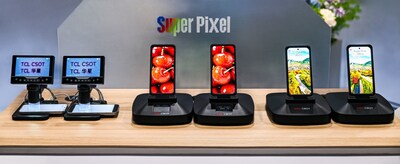
TCL CSOT is redefining next-generation FMM OLED performance with Super Pixel technology, which delivers a powerful trifecta of benefits:
- Higher Clarity: Achieves sharpness comparable to WQHD SPR. By increasing the sub-pixel quantity by approximately 1.8%, it renders images that are more accurate, clear, and finely detailed.
- Smarter Power Use: Optimized data processing reduces power consumption by up to 25% while maintaining exceptional image quality.
- Rapid Refresh: Leverages a Real RGB pixel layout that requires less bandwidth than SPR, enabling refresh rates up to 40% higher for smoother motion.
TCL CSOT is showcasing a suite of groundbreaking Super Pixel mobile displays, each designed to push the boundaries of clarity, efficiency, and refresh performance.
- World's First Super Pixel High-Clarity Mobile Display (6.9"): This display delivers an ultra-high 2608×1200 resolution and 420PPI on a 6.9-inch screen, producing razor-sharp text and finely detailed textures. Its ultra-narrow bezels (0.5mm top, 0.8mm sides) create a stunningly immersive, edge-to-edge viewing experience.
- World's Lowest-Power Consumption Super Pixel Mobile Display (6.9"): Setting a new benchmark in energy efficiency, this 420PPI display combines Super Pixel density with an 8T LTPO ultra-low-power architecture. It reduces IC power consumption by 10% and SoC power consumption by 25% compared to conventional solutions, extending battery life without compromising its 2000 nit peak brightness.
- World's First Super Pixel High Refresh Rate Mobile Display (6.9"): Designed for next-generation gaming, this display features an ultra-fast 165 Hz refresh rate, improving motion smoothness by 40% over 120 Hz panels for tear-free visuals. Its 7T LTPS architecture intelligently adapts between 60–165 Hz to balance performance and power efficiency.
IJP OLED: Superior Quality with Greater Flexibility
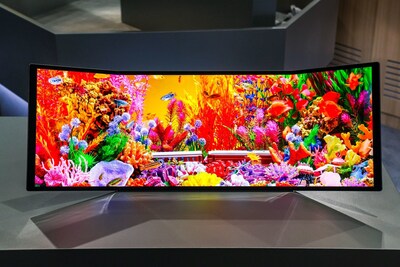
Building on TCL CSOT's decade-long leadership in IJP OLED and its construction of the world's first 8.6-generation IJP OLED production line (t8), the company is showcasing how IJP OLED technology is transforming the industry with significant advantages in manufacturing and performance. TCL CSOT's pixel innovation in this area delivers:
- Process Advantages: Reduces reliance on complex vacuum procedures and flexibly adapts to different panel sizes through scalable printhead configurations.
- Image Quality: Real Stripe RGB pixel arrangement ensures exceptional clarity and true-to-life color accuracy.
- Power Optimization: By creating larger light-emitting areas (50%–60% of the pixel), the technology improves luminous efficiency and lowers overall power consumption.
TCL CSOT is showcasing this innovation through the World's First Foldable & Portable IJP OLED Monitor Display (28"). Featuring a revolutionary tri-fold design, it transforms a compact 16-inch device into an expansive 28-inch ultra-wide screen, demonstrating IJP OLED's unique capability to enable flexible, high-performance designs that expand the boundaries of display applications.
LCD Innovation: Advancing with RGBC Four-Color Technology
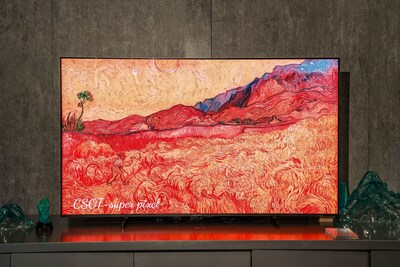
TCL CSOT is advancing LCD technology for the large-screen domain by incorporating an innovative four-color (RGBC) pixel array.
- Expanded Color Gamut & Accuracy: By adding a fourth (Cyan) sub-pixel to the traditional RGB system, the display can directly generate more saturated and realistic colors, significantly expand the color gamut and enhance color accuracy, especially in cyan tones.
- Enhanced Resolution: The four-color system increases the sub-pixel count and utilizes optimized rendering algorithms to markedly improve resolution, delivering superior performance, especially when rendering high-frequency image details.
This innovation is demonstrated in the World's Highest Image Quality WHVA Ultra LCD TV Display (85"), featuring a native RGBC four‑color pixel array that achieves 131% of the BT.2020 color gamut. Delivering true four‑color performance at the hardware level, it sets a new benchmark for LCD innovation with exceptionally vivid, natural, and clear images.
By continuously evolving its technology portfolio to meet diverse scenarios, TCL CSOT demonstrates its commitment to setting new standards in display innovation and ensuring that advanced display solutions enrich everyday life for users worldwide.
- End -
About TCL CSOT
Established in 2009, TCL China Star Optoelectronics Technology Co., Ltd. (TCL CSOT) is a leading global innovator in display technologies. Its LCD, OLED, and MLED solutions power applications across TVs, smartphones, tablets, laptops, monitors, automotive systems, VR/XR, and commercial displays. With a clear strategic direction set by its advanced display technology brand APEX, TCL CSOT invests continuously and strategically in R&D, driven by a mission to amaze, protect and inspire all people through endlessly innovative display technology. As part of TCL's Worldwide Olympic Partnership, TCL CSOT is proud to deliver display solutions that elevate experiences on the global stage.
Photo - https://mma.prnewswire.com/media/2973724/WhatsApp_Image_2026_05_06_at_4_12_55_PM__1.jpg
Photo - https://mma.prnewswire.com/media/2973723/WhatsApp_Image_2026_05_06_at_4_12_55_PM.jpg
Photo - https://mma.prnewswire.com/media/2973722/WhatsApp_Image_2026_05_06_at_4_12_54_PM.jpg
 View original content:https://www.prnewswire.co.uk/news-releases/tcl-csot-showcases-apex-pixel-full-path-innovation-across-advanced-displays-at-sid-display-week-2026-302764114.html