Sunwoda Digital Battery Passport Solution Among Finalists at 2026 edie Energy & Tech Awards
LONDON, Oct. 16, 2026 /PRNewswire/ -- The 2026 edie Energy & Tech Awards ceremony took place in London today, with Wang Qiao, General Manager of Sunwoda Hungary, attending on behalf of the company. Sunwoda's Digital Battery Passport Solution was among the nine finalists in the Supply Chain & Scope 3 Decarbonisation Project of the Year category.
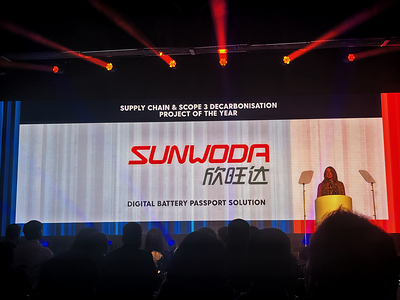
Organised by UK sustainability media platform edie, the category recognises value-chain decarbonisation through supplier engagement, procurement and improved data. Other finalists included Prologis and Mobilityways' Green Travel Programme, Syngenta's Collaborative Carbon Reduction and HH Global's Sustainable Procurement Framework. Sunwoda brought a battery lifecycle data solution to this cross-sector field.
The solution links battery value-chain data to support product carbon footprint management and sustainability disclosures. Battery data spanning raw material sourcing, manufacturing, use and recycling is dispersed among suppliers, manufacturers and downstream partners, complicating carbon accounting and traceability. Sunwoda's solution links product identity, carbon footprint and compliance information in one digital record. This supports emissions hotspot identification, supply-chain coordination and product sustainability disclosure preparation.
Development began in 2023, with collaborative pilots in 2024 and the platform's launch in October 2025. Six modules cover supply chain management, traceability mapping, product carbon footprint, due diligence, passport management and operational management. Covering 78 indicators, the platform integrates material sourcing, environmental performance and compliance records, helping partners collect and access information about the same battery product. Secure data exchange and permission-based access support collaboration while protecting data.
The platform has progressed to practical applications. In 2024, two battery passport projects jointly developed by Sunwoda and its partners were selected for the Global Battery Alliance's Battery Passport pilot programme. According to edie's project profile, Sunwoda completed five pilots in 2025 and engaged 28 key suppliers in carbon management.
Sunwoda has collaborated on battery passport development and applications with well-known domestic and international companies, including TÜV Rheinland and Siemens China. These collaborations build experience linking battery information across organisations and stages of use.
From 18 February 2027, the EU Battery Regulation requires passports for electric vehicle batteries, light means of transport batteries and industrial batteries above 2 kWh placed on the EU market or put into service. Sunwoda plans to release phase two of its battery passport platform in mid-December 2026. Before implementation, platform development and collaborative applications will help customers prepare battery disclosures and connect supply chain information.
 View original content to download multimedia:https://www.prnewswire.co.uk/news-releases/sunwoda-digital-battery-passport-solution-among-finalists-at-2026-edie-energy--tech-awards-302911467.html




