GLN International Expands QR Payment Coverage Across Mainland China Through Weixin Pay Network
- Expands QR payment coverage across broader everyday payment scenarios in China following UnionPay connectivity
- Enables seamless payments at Weixin Pay merchants across China without installing local apps
- Strengthens GLN's cross-border payment infrastructure through partnerships with Tenpay Global and UnionPay International
SEOUL, South Korea, May 14, 2026 /PRNewswire/ -- GLN International ("GLN"), the global cross-border payment platform subsidiary of Hana Bank led by CEO Suk Lee, announced the expansion of its QR payment coverage across Mainland China through integration with the Weixin Pay (WeChat Pay) network operated by Tenpay Global.
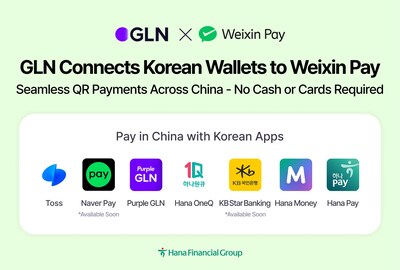
Through this expansion, GLN users can now make QR payments not only at existing UnionPay-affiliated merchants, but also across the broader Weixin Pay merchant ecosystem widely used throughout China. The expanded coverage enables users to pay seamlessly across a wide range of everyday payment scenarios, from street food and shopping to subway rides and taxi fares, providing a more convenient payment experience for travelers in China.
The latest integration builds upon GLN's existing partnership with UnionPay International established last year, further strengthening GLN's payment infrastructure coverage across China. By connecting both UnionPay and Weixin Pay networks, GLN significantly expands QR payment accessibility for outbound travelers.
Unlike conventional overseas payment services that often require separate local apps or physical cards, GLN allows users to pay directly through familiar Korean financial and platform apps already used in Korea. The service is currently available through Purple GLN, Hana OneQ, Hana Money, Hana Card, and Toss, with additional partner channels including Naver Pay and KB Star Banking expected to launch sequentially.
"Through this expansion, travelers will be able to enjoy a more seamless QR payment experience across a much wider range of everyday scenarios in China," said Suk Lee, CEO of GLN International. "GLN will continue leading its global payment network to provide users with the same simple and convenient payment experience overseas as they enjoy at home."
About GLN International
GLN International, a subsidiary of Hana Bank under Hana Financial Group, is a leading cross-border payment infrastructure provider in Asia. The company provides QR payment and QR cash withdrawal services across 14 countries, including Vietnam, Mainland China, Japan, Thailand, the Philippines, Laos, Taiwan, Singapore, Hong Kong SAR, Macau, Guam, and Saipan, connecting users to more than 200 million QR merchants worldwide.
Photo - https://mma.prnewswire.com/media/2979862/PRNewswire_GLN_Image.jpg
 View original content:https://www.prnewswire.co.uk/news-releases/gln-international-expands-qr-payment-coverage-across-mainland-china-through-weixin-pay-network-302771708.html